
By Ahmed Deepto and Mohiuddin Alamgir
Originally posted in The Daily Star on 27 January 2026
The February 12 election is set to be held under the watch of the largest contingent of local and international observers since the 2008 polls.
The extended presence of observers, from grassroots civic groups to seasoned international missions, reflects a surge in both domestic vigilance and global curiosity about the country’s democratic transition.
They said this election is widely hoped to be the first competitive contest since 2008, when Bangladesh last witnessed largely accepted and participated polls.
International and local observers noted that their mandate extends beyond simply watching events on election day. While short-term monitors focus on polling and counting, long-term international observers usually track the broader process — examining preparations, the legal framework, and its enforcement, the conduct of campaigns, and the mechanisms for resolving electoral disputes, said EC officials.
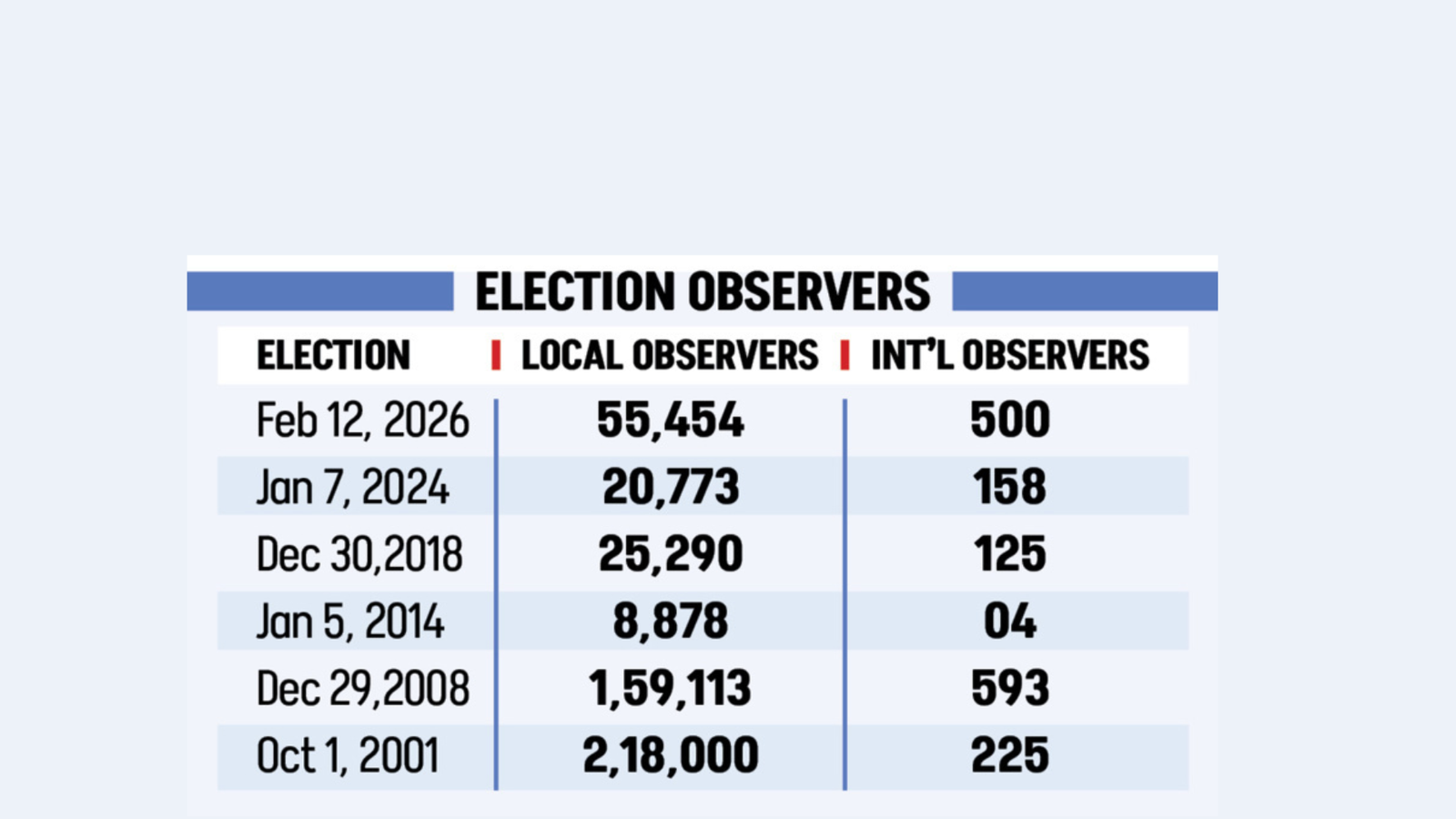
Election Commissioner Brig Gen (retd) Abul Fazal Md Sanaullah said 55,454 observers from 81 registered local organisations will be on duty. In addition, there will be around 500 foreign observers monitoring the polls.
A total of 1,59,113 local and 593 international observers monitored the 2008 polls.
Polls expert Badiul Alam Majumdar, also chief of the now-defunct Electoral Reform Commission, told The Daily Star that the number of local and international observers has increased significantly as a competitive election is set to be held on February 12.
“Many international observers showed apathy in monitoring the three previous polls, as they were not contested. In many cases, they faced various obstacles, including being denied visa,” he said.
Although parliamentary polls are scheduled every five years, this election comes just two years after the last one, following the fall of the Awami League regime, which had remained in power since 2008.
The 2014 and 2024 elections were condemned as “one-sided”, as almost all opposition parties boycotted them. Even 153 MPs were elected unopposed in the 2014 polls.
In the 2018 national polls, ballot boxes were reportedly stuffed on the eve of voting. BNP and other opposition parties did not take part in the 2014 and 2024 polls. In 2018, BNP contested under the “Jatiya Oikyafront” banner but faced widespread intimidation and received little redress from the Election Commission.
Of the local observers monitoring the February 12 election, 7,997 will be stationed in Dhaka and 47,457 others across the country.
Among the international observers, the European Union has planned to deploy up to 200 observers for the polls. Of them, 56 are long-term observers, who are in Dhaka, marking the first such mission since 2008.
The Commonwealth mission, whose pre-election team visited Bangladesh in October last year, will comprise 14 observers.
Bangkok-based Asian Network for Free Elections (ANFREL) conducted a pre-election assessment mission in Bangladesh from November 21 to December 5, 2025. It will send a 28-member mission.
International Republican Institute (IRI), a US-based think tank, will send at least 10 observers. An IRI pre-election delegation visited Bangladesh in October last year and published its report.
The number of observers from the US, including the IRI delegation, can increase, said EC officials.
Besides, 25 international freelance observers, including the former Nepalese chief election commissioner, have also shown interest in monitoring the polls, they added.
The EC has invited representatives from election authorities around 50 countries and international organisations to observe the polls.
Munira Khan, president of the Fair Election Monitoring Alliance (Fema), told this newspaper, “International interest in how free and fair election will be has grown compared to previous years, as the last three polls were not credible.”
Another reason for the increased attention is the interim government led by Nobel laureate Prof Muhammad Yunus, she added.