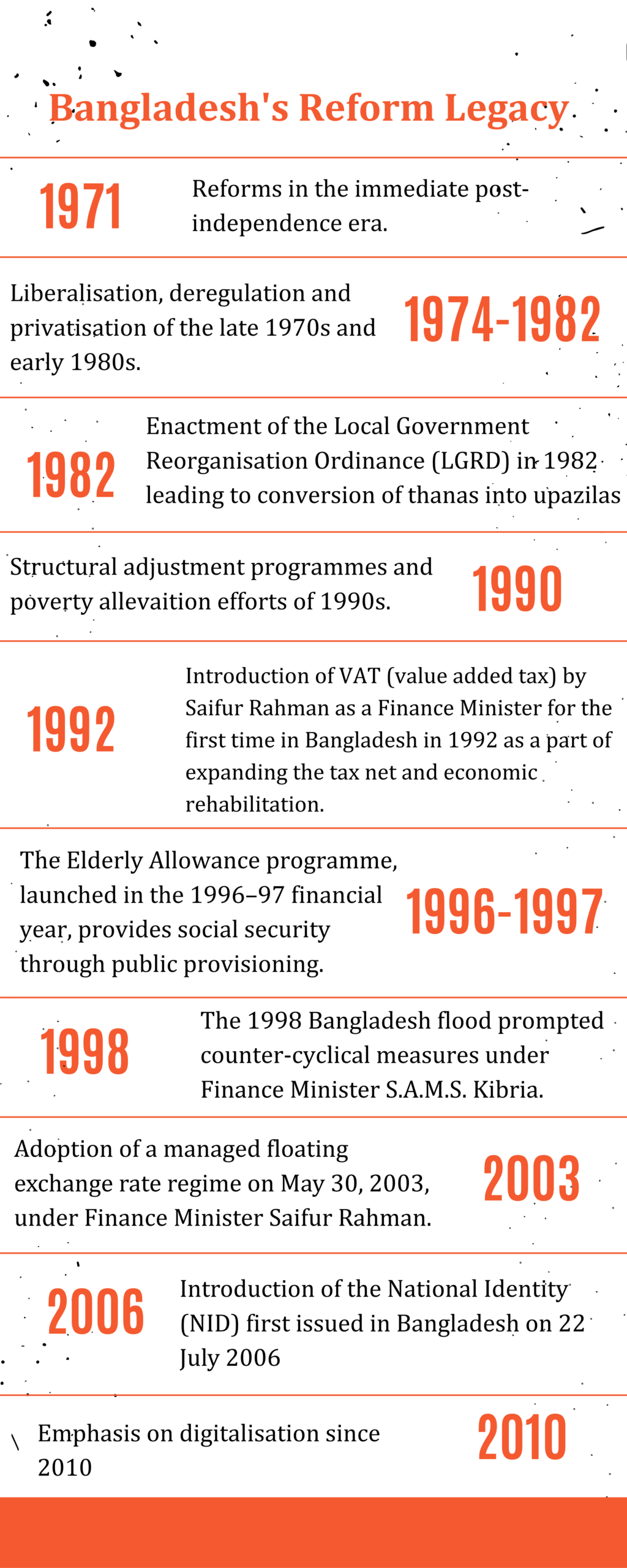

Bangladesh is not new to attempts at reform; some originated from utter necessity, while others emerged in response to pressures exerted by development partners. Over the decades, the country has experienced waves of economic, political, and institutional restructuring—driven by macroeconomic pressures, shifting political incentives, and critical junctures that created opportunities for change. These reforms aimed to address challenges concerning institutional effectiveness, macroeconomic management, and the functioning of organs of state, particularly in the general area of good governance. The success of such endeavours, however, critically hinged on political commitment and overcoming of vested interests, far more than on technical capacity alone. When this was not possible, reforms either failed or did not deliver the expected results. As the post-August 2025 landscape attempts to reshape institutions and governance and adhere to public expectations, revisiting Bangladesh’s reform trajectory has assumed heightened importance.
A prolonged democratic deficit in Bangladesh gave rise to an entrenched anti-reform coalition comprising political elites, business leaders, and high-level government functionaries. They resisted reform attempts by blocking anti-corruption measures, undermining good governance, and thwarting pro-competition market reforms. Over time, crony capitalism evolved into a kleptocracy, capturing political and economic levers, undermining policy sovereignty, and increasingly weakening the state’s capacity to undertake meaningful reforms.
The ruling class forgets that good reforms are not only good economics, but also good politics. It has learned it the hard way. The critical question now is whether the next crop of rulers will be able to learn from past experiences.
The Bangladesh Reform Tracker intends to make sure that it does. Remaining mindful of the historical perspective, the Tracker maintains transparency while respecting confidentiality, and recognises the risks, incentives, and systemic pressures that can cause reforms to fall short—factors that shape the “demand-side” of a national reform trajectory.