
Originally posted in The Daily Star on 28 January 2026
All 1,981 candidates contesting the upcoming February 12 polls have declared their election expenditures in their affidavits, bringing the combined total to a little under Tk 400 crore.
Experts, however, say the figure is far from realistic and does not reflect the true costs of poll campaigns.
According to Transparency International Bangladesh’s (TIB) “Know Your Candidate” portal, BNP candidates plan to laregly meet their expenses from personal funds, 56 percent coming from their own pockets.
In contrast, Jamaat-e-Islami reported that 58 percent of its campaign budget will be financed through grants and donations, including party funds. The National Citizen Party stated that 62 percent of its election spending will rely on grants and donations.
Across all parties, the total expenditure amounts to Tk 396 crore.
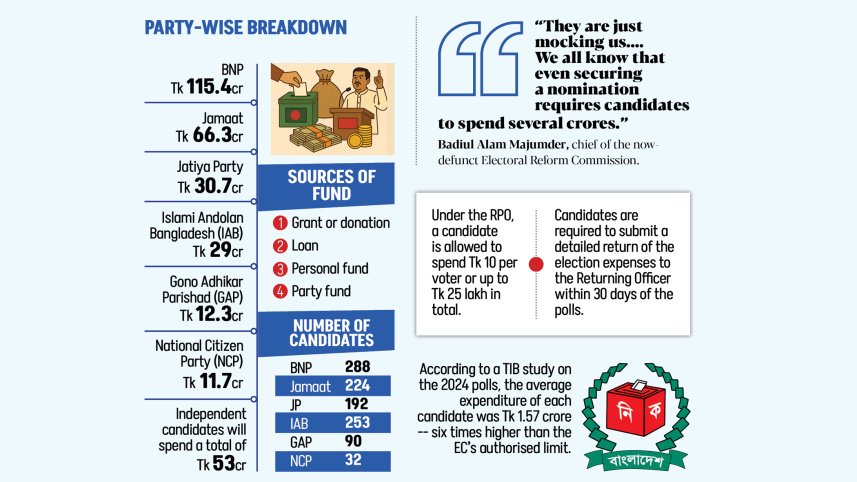
Of the total, BNP has declared Tk 115.4 crore spending for its 288 candidates, Jamaat Tk 66.3 crore for 224 candidates, Jatiya Party Tk 30.8 crore for 192 candidates, Islami Andolan Bangladesh (IAB) Tk 29 crore for 253 candidates, Gono Odhikar Parishad Tk 12.3 crore for 90 candidates, and NCP declared the lowest — Tk 11.7 crore for 32 candidates.
Independent candidates together will spend a total of Tk 53 crore.
TIB’s Outreach and Communication Director Mohammad Tauhidul Islam said they had compiled the information provided by candidates in their affidavits and elaborated that each political party’s funding is also counted as a grant or donation.
“Similarly, when a supporter or well-wisher voluntarily contributes money to the party, it also falls under the category of grants or donations. In many cases, candidates also borrow from relatives or close acquaintances to cover expenses.”
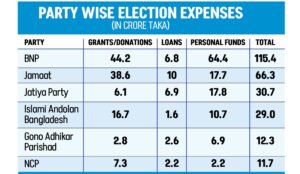
According to the TIB portal, BNP candidates announced that of the total funding, Tk 44.2 crore will come from donations or grants, Tk 6.8 crore from loans, and Tk 64.4 crore from the party’s own funds.
Jamaat candidates declared that Tk 38.6 crore will come from donations and grants, Tk 10 crore from loans, and Tk 17.7 crore from its funds.
Jatiya Party candidates will get Tk 6.1 crore from grants and donations, Tk 6.9 crore from loans, and Tk 17.8 crore from own funds.
IAB candidates will get Tk 16.7 crore from grants or donations, Tk 1.6 crore from loans, and Tk 10.7 crore from its funds.
Gono Odhikar Parishad candidates will use Tk 2.8 crore from grants and donations, Tk 2.6 crore from loans, and Tk 6.9 crore from own funds.
NCP candidates will get Tk 7.3 crore from grants and donations, Tk 2.2 crore from loans, and the same amount from party funds.
The Representation of the People Order, 1972 allows a candidate to spend Tk 10 per voter, up to a maximum of Tk 25 lakh, based on the number of voters in the constituency.
In addition, candidates are required to submit a detailed return of their election expenses to the Returning Officer concerned within 30 days of the polls.
Asked about the affidavit declarations, polls expert and chief of the now-defunct Election Reform Commission, Badiul Alam Majumdar, smiled. “They are just mocking us… We all know that even securing a nomination requires candidates to spend several crores.”
He added that candidates never keep their expenses within the ceiling.
According to a February 2025 report titled “The cost of politics in Bangladesh” by the Westminster Foundation for Democracy, elections in Bangladesh are an expensive affair, with candidates spending between Tk 5-10 crore to secure nominations and run their campaigns.
The rising costs of electioneering have created barriers for many aspiring politicians, particularly those from less affluent backgrounds and marginalised communities, including women, the report said.
The research for the report was conducted between July and December 2024. As many as 25 in-depth key informant interviews were conducted with former members of parliament, election officials, and other stakeholders, while two focused group discussions were held.
Researchers also gathered data from secondary sources, including government publications, prominent international organisations, and academic literature examining the political economy of Bangladesh.
During the campaign phase, candidates need to spend Tk 3 crore to Tk 5 crore or more, depending on the constituency and level of competition.
They also have to spend money on polling day to secure votes. A minimum of Tk 50 lakh was spent on average per candidate on election day, according to the report.
“Vote-buying” was a feature of all 2024 polls, with payments per vote ranging from Tk 1,000 to Tk 5,000.
Even after winning the election, some candidates need to spend another Tk 4-5 lakh to expedite administrative processes, such as the official publication of election results or other necessary documentation.
According to a TIB study on the 2024 election, the average expenditure of each candidate from before the announcement of the schedule until voting day was Tk 1.57 crore — six times higher than the limit authorised by the Election Commission (maximum Tk 25 lakh per candidate). The study covered 50 seats.
TIB Executive Director Iftekharuzzaman said, “Considering the overall activities and spending pattern of the parties, it can reasonably be assumed that they have already crossed the prescribed limits long ago.”
He added, “Nothing will change much unless our political leaders reform themselves and their parties. In the meantime, at least some visible changes could be expected if three key relevant oversight institutions — EC, ACC [Anti-Corruption Commission] and NBR [National Board of Revenue] — had the courage and commitment to play their due roles to ensure accountability for non-compliance.
“For the EC, this means questioning the validity of candidacy in cases of campaign overspending or discrepancies between affidavit disclosures and reality; for the NBR, ensuring accountability for tax evasion reflected in affidavit data and campaign expenses; and for the ACC, acting against corruption, including the accumulation of wealth and income beyond legitimate means.”
Contacted by The Daily Star yesterday, a top EC official admitted that candidates spend more than they declare in their affidavits.
“They are required to maintain a separate bank account for campaign expenses. In practice, however, much of the financial flow often bypasses formal banking channels. Large sums of money — sometimes in crores — are exchanged informally, making it extremely difficult to detect or prove instances of bribery or illicit transactions.”
Officials acknowledge that scrutiny of these accounts remains a major challenge.
Election Commissioner Abdur Rahmanel Masud said they will examine the submitted accounts carefully. “If black money is used to buy votes, it undermines the people’s free will and distorts the democratic process…. We will strengthen scrutiny of expenditure reports for the upcoming polls.”